
The Franklin County Inmate Population
The local jail count in Franklin County is small by any measure. The county holds about 12,594 residents, a figure the Franklin County Sheriff's Office 2024 Annual Report drew from the 2023 Census estimate. One agency runs the jail and reports its numbers: the Franklin County Sheriff's Office (FCSO), led by Sheriff A.J. "Tony" Smith. The jail at Eastpoint is the single local detention point for arrests made across the county.
Not everyone behind bars in Franklin County is part of the same count. The jail holds people arrested by local agencies, defendants waiting for trial, and inmates serving short county terms. Two state prisons also sit inside the county near Carrabelle, but the people there belong to a separate state count. Several forces move the local number. Arrests add to it. Bond decisions and releases lower it. Felony sentencing moves people out to state prison.
Franklin County Inmate Population Statistics
The clearest local numbers come from one source: the Franklin County Sheriff's Office 2024 Annual Report. It lists the jail's maximum capacity as 100 and its average daily population (ADP) as 66. ADP is the mean number of inmates held on a typical day across the year. The same report counts 671 inmates booked during 2024. Capacity, ADP, and yearly bookings form the backbone of the local count.
The table below sets the headline measures side by side, each tied to its source. The incarceration rate is a calculation, not a published sheriff statistic, so it is labeled that way. Using the 2024 ADP of 66 against the county estimate of 12,594 residents gives a rough local jail rate near 524 inmates per 100,000 people.
| Measure | Figure | Source / Year |
|---|---|---|
| Average daily population | 66 | FCSO 2024 Annual Report |
| Rated / bed capacity | 100 | FCSO 2024 Annual Report |
| Annual bookings | 671 | FCSO 2024 Annual Report |
| Incarceration rate (per 100k) | about 524 | Calculated from FCSO 2024 figures |
The U.S. Census QuickFacts page is a useful cross-check for the county population that drives that rate. The lead-in below links it before the image. The Census QuickFacts table for Franklin County, Florida reports the resident estimate used to size the local jail rate.
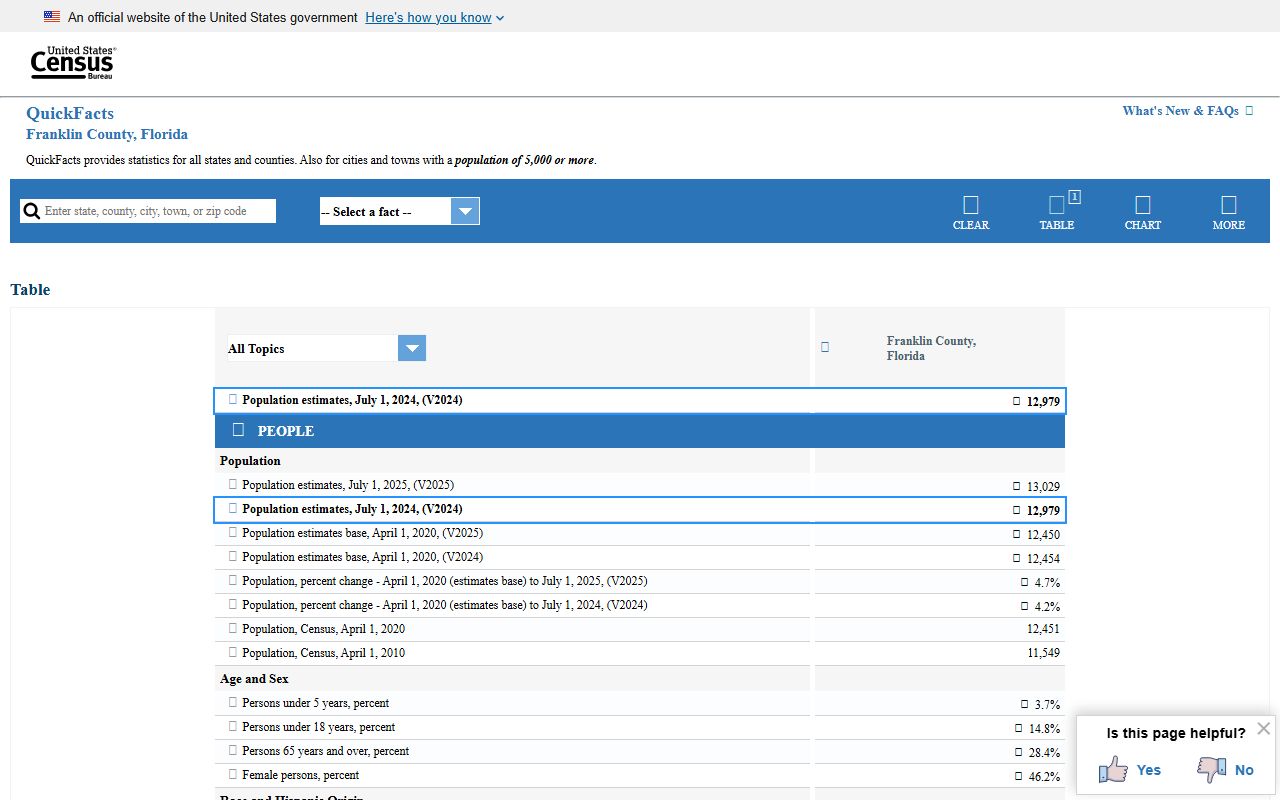
That resident count is the denominator behind the calculated jail rate, which is why the population page matters as much as the jail report itself.
Franklin County Jail Operational Figures
A single year of ADP cannot show a trend on its own. The Franklin County Sheriff's Office 2024 Annual Report publishes the 2024 jail ADP of 66, but prior-year jail ADP figures were not located in official sources during research. Rather than invent earlier numbers, the honest picture comes from the operational totals the 2024 report does publish, showing how the jail moved people through court, medical care, and state transfer.
| Operational Measure | 2024 Figure | Source |
|---|---|---|
| Court escorts, felony and misdemeanor | 153 | FCSO 2024 Annual Report |
| Inmates transported to DOC after sentencing | 32 | FCSO 2024 Annual Report |
| Outside medical transports | 12 | FCSO 2024 Annual Report |
| Inmates attending programs | 268 | FCSO 2024 Annual Report |
| Average daily cost per inmate | $89.42 | FCSO 2024 Annual Report |
| Meals served | 71,449 | FCSO 2024 Annual Report |
| Nursing-staff visits | 1,172 | FCSO 2024 Annual Report |
| Prescriptions processed | 4,004 | FCSO 2024 Annual Report |
These are workload counts, not headcounts. The same inmate can be seen by a nurse more than once or escorted to court many times.
Note: meals served and nursing visits measure jail workload across the year, so they should never be read as a count of separate inmates.
Who Makes Up the Franklin County Inmate Population
People often want a breakdown by sex, race, or charge type. Franklin County does publish those traits, but only at the level of each individual arrest. Each entry on the sheriff's public arrest log shows the person's race, sex, age, city, arresting agency, date, and charges. Read one entry and you see one person's details in full.
The aggregate picture is the gap. The Franklin County Sheriff's Office 2024 Annual Report does not break the jail's 66 average daily population into demographic categories. It does not split the count by male and female, by race, by age band, by felony and misdemeanor, or by pretrial and sentenced status. Because those shares were not published, no percentages are invented here. To study the makeup of recent bookings, a reader can browse the arrest-log entries one by one.
Franklin County Jail Capacity and Occupancy
Capacity and population are two different ideas. Maximum capacity is the size of the building: 100 beds, per the 2024 report. Average daily population is how full it actually ran: 66 on a typical day. Set one against the other and the jail averaged 66 percent occupancy in 2024, a figure calculated from the FCSO 2024 figures rather than published as a percentage by the sheriff.
That math matters for one common claim. With an average of 66 against a rated 100, the sheriff's own 2024 numbers do not support an overcrowding label. No consent decree, no U.S. Department of Justice jail investigation, and no active overcrowding lawsuit involving the Franklin County Jail was located during research. Daily counts can swing above the yearly average, so the jail can still be busy on a given night, yet the published average sits below the rated bed count.
Laws Governing the Franklin County Inmate Population
The reason these figures and records are public at all comes down to Florida law. Florida's public-records framework makes most jail and booking information open to inspection, subject to exemptions. A separate set of statutes governs how the county jail itself must be run and what standards it must meet. Together they explain both why the numbers can be requested and how the facility is held to a standard. The callout below pairs each statute with a plain-English meaning.
Key Statutes:
Florida Statutes Chapter 119 - Florida's public-records law gives the general right to inspect and copy nonexempt records held by agencies like the sheriff.
Florida Statutes § 119.07 - Agencies must allow inspection and copying within a reasonable time and may charge for copies or extensive staff work.
Florida Statutes § 951.23 - This is Florida's standard for county and municipal detention facilities, covering jail administration and operating requirements.
Florida Statutes Chapter 951 - The broader chapter governing county and municipal prisoners and local detention responsibilities.
Florida Administrative Code Chapter 63M-2 - State jail-standards rules that supply the operational detention standards a county facility must follow.
Franklin County and the State Prison Population
Two state prisons sit inside Franklin County, both near Carrabelle. Franklin Correctional Institution holds sentenced adult male prisoners, and the Franklin Work Camp holds sentenced inmates in a work-camp setting. Both are run by the Florida Department of Corrections (FDC), not by the sheriff. That distinction is the whole point of this section.
The people held at those two prisons are counted in the state prison population, not in the county jail's average daily population. Adding them together would double-count and mislead. The honest link between the two systems is movement after sentencing. In 2024 the sheriff reported 32 inmates transported to FDC after they were sentenced. That is the local bridge: a person booked into the county jail, sentenced on a felony, and handed off to the state. After that handoff the lookup tool changes from the sheriff's records to the FDC offender search.
How to Search the Franklin County Inmate Population
Searching for one person in Franklin County works differently than in many counties. The sheriff publishes an official Franklin County arrest log, but it is a paginated list of arrest entries, not a fielded live roster. There is no box to type a last name. Instead you browse the entries and match the person by photo, name, city, agency, date, and charges. The arrest log carries arrests made by the Franklin County Sheriff's Office, the Apalachicola Police Department, and the Carrabelle Police Department.
Before you start, have the person's full name and a rough arrest date. Because the log does not show release status or housing, a hit on the log does not prove someone is still in custody. The steps below walk through it.
- Open the official Franklin County Sheriff's Office Arrest Log and start on page one with the newest entries.
- Browse or paginate through the entries. The archive runs deep, with page numbers reaching past page 200 and a "Next" link.
- Match the person by booking photo, full name, city, race, sex, age, arresting agency, and date.
- Read the charge list, which shows the Florida statute citation and a plain-language description for each charge.
- Confirm current custody by phone or a records request, since the log does not publish live housing, bond, or release fields.
- If the person was sentenced to state prison, switch to the FDC offender search instead of the county arrest log.
The sheriff's homepage is the gateway to the arrest log and the public-records page. The lead-in below links the homepage before the image. The Franklin County Sheriff's Office homepage carries the top navigation to the Arrest Log, Divisions, Resources, and Contact.
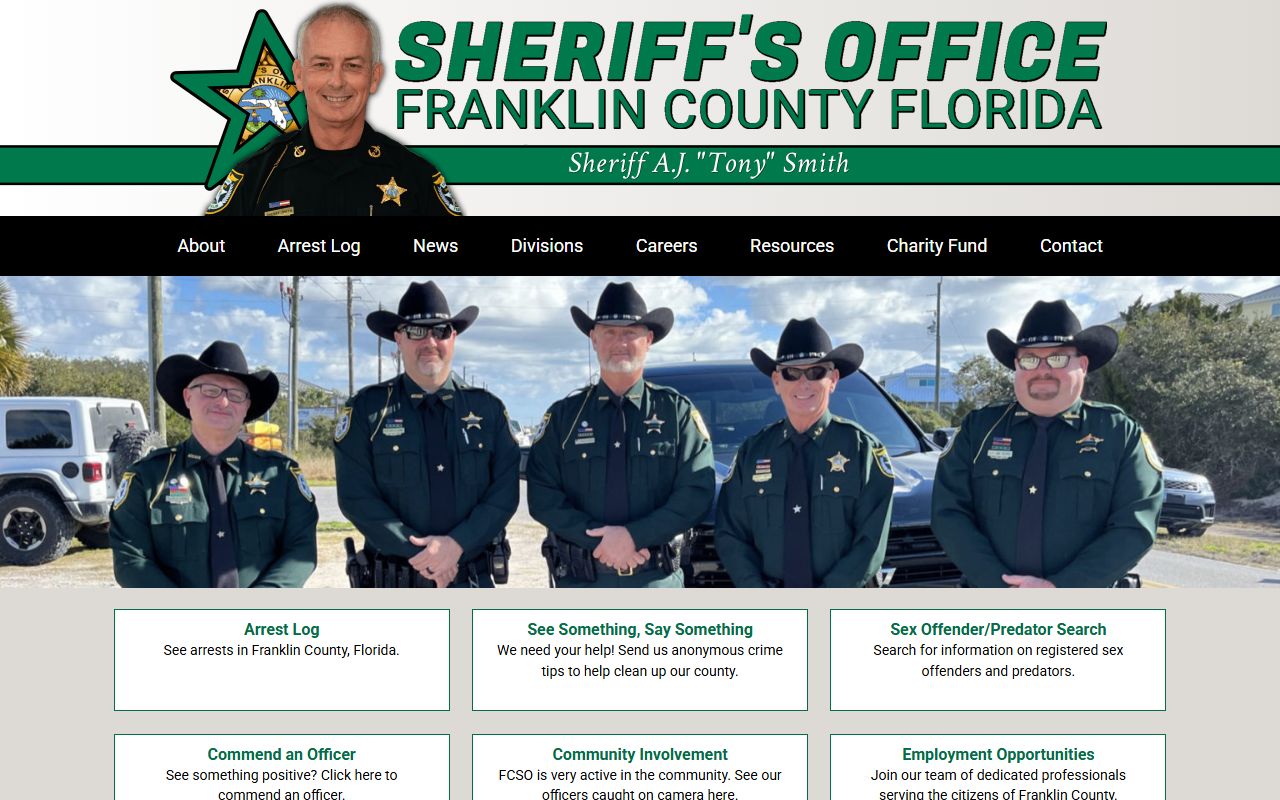
From there, the Arrest Log link is the main public channel for browsing recent Franklin County bookings.
What a Franklin County Arrest Entry Shows
Each arrest-log entry is a record, not a searchable profile. The fields that appear are consistent, and so are the fields that do not. The table below lists what the public arrest log displays and what it leaves out. For deeper booking documents, the path is a public-records request rather than the log itself, and the county's broader jail inmate records options pick up where the log stops.
| Field | Shown on the Arrest Log? |
|---|---|
| Booking photo / mugshot | Yes, one image beside the entry |
| Full name | Yes |
| City | Yes |
| Race | Yes |
| Sex | Yes |
| Age | Yes, age in years, not date of birth |
| Arresting agency | Yes, FCSO or a city police agency |
| Arrest date | Yes, in MM/DD/YYYY format |
| Charges | Yes, statute citation plus charge phrase |
| Booking number | No, not shown |
| Bond amount | No, not shown |
| Housing unit | No, not shown |
| Court date | No, not shown |
| Release status | No, not shown |
| Warrant number | No, not shown |
Note: because release status never appears on the arrest log, an old entry may stay online long after the person has been released, transferred, or sentenced.
Past and Released Inmate Records
Finding someone no longer in the local jail takes a different route. The arrest-log archive itself runs deep, with pagination reaching page 234, so older arrests may still appear if you browse back far enough. The page does not publish a retention policy, so there is no stated cutoff for how long an entry stays online. For booking records, arrest reports, or photos that are not visible on the log, the official fallback is a Chapter 119 public-records request.
Those requests go to the sheriff's public-records contact, Dana Pavon, at 850-670-4807 or PublicRecords@franklinsheriff.com. Florida law does not require a requester to give a name, but the office needs a way to deliver the response. Including the FCSO case number helps, or the incident location, date, and time if it is unknown. One limit applies: if a report is open or a capias has been requested, it may be withheld from most requesters until the case closes. For someone sentenced to state prison, the trail moves into the FDC offender locator instead.
County Jail vs. State Prison: Where to Look
The most common search mistake is using the wrong system for the wrong custody level. Pretrial defendants and people serving short local terms sit in the county jail, searched through the sheriff's arrest log. Sentenced felons move to a state prison run by the Florida Department of Corrections, searched through the FDC offender locator. The two systems answer different questions and hold different parts of the inmate population. The comparison below makes the split clear.
| County Jail | State Prison (FDC) | |
|---|---|---|
| Who Is Held | Pretrial detainees and local sentenced inmates | Sentenced felons after classification |
| Run By | Franklin County Sheriff's Office | Florida Department of Corrections (FDC) |
| Where to Look | FCSO arrest log | FDC offender search |
| ID Used | Name, city, arrest date | DC number or name |
State and Federal Inmate Search
Once custody moves past the county jail, the lookup tool changes with it. Each system below covers a separate slice of the broader inmate population, so the right tool depends on where the person is held. The lead-in below links the state locator before the image. The Florida Department of Corrections offender search covers sentenced state prisoners by name or DC number.
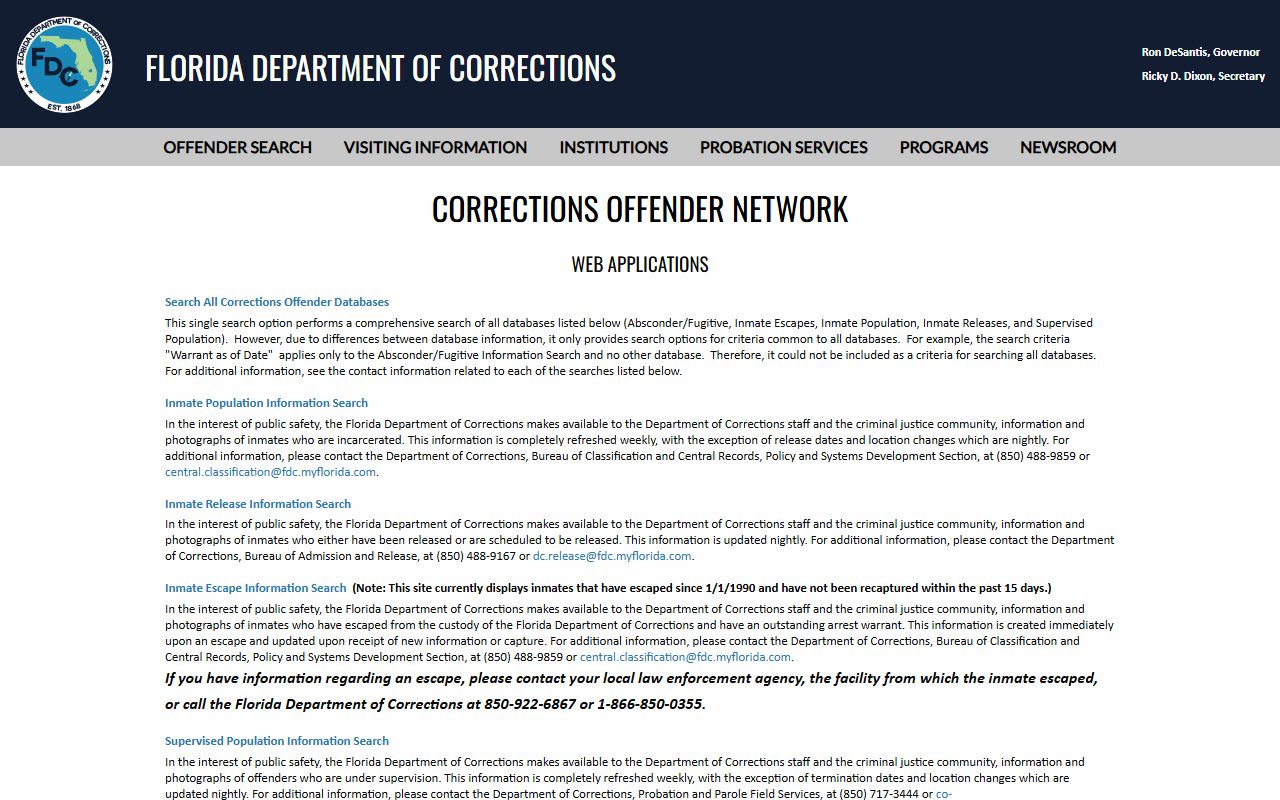
That FDC search is the right tool for anyone transported to state prison after a Franklin County felony sentence. For other custody levels, use these channels:
- Federal prisoners - the Federal Bureau of Prisons inmate locator covers sentenced federal inmates from 1982 forward.
- Immigration detainees - the ICE Online Detainee Locator System searches by A-Number and country of birth or by biographical detail.
- Custody notification - VINELink Florida sends alerts about a person's release or transfer rather than serving as the originating record.
The sheriff also links an official FCSO mobile app from its Resources menu, and the app page advertises access to arrests. Treat it as an extra arrest-access channel, not a confirmed live roster, since it is not monitored around the clock.
Franklin County Detention Facilities
Three facilities hold part of the inmate population tied to Franklin County, and each holds a different group. One is the local jail. The other two are state prisons that happen to sit inside the county. Listing them together helps explain why a single name can show up in different record systems.
- Franklin County Jail - the local jail in Eastpoint, holding pretrial detainees and county-sentenced inmates booked by Franklin County agencies.
- Franklin Correctional Institution - a Carrabelle state prison holding sentenced adult male prisoners in FDC custody.
- Franklin Work Camp - an FDC work camp tied to the Carrabelle complex, holding sentenced state inmates in a work-camp setting.
Inmate Population Terms Defined
A few terms come up again and again across jail records, court files, and state prison data. Short definitions keep the rest of the search clear.
- Booking
- The jail intake process that records a person's arrest, identity, charges, fingerprints, photo, and custody status.
- Average daily population (ADP)
- The mean number of inmates held on a typical day across a year. Franklin County's 2024 ADP was 66.
- Pretrial
- The stage after arrest but before a case is resolved, when a defendant may be held or released on bond.
- Capias
- A court order or writ directing an arrest, often issued after a missed court date or unresolved case event.
- Detainer
- A hold or notice from another agency that can keep a person in custody even after local bond is posted.
- DC number
- The Florida Department of Corrections identification number assigned to a sentenced state prisoner.
Franklin County Inmate Population FAQ
How big is the Franklin County inmate population?
The Franklin County Sheriff's Office 2024 Annual Report lists the jail's average daily population as 66 against a maximum capacity of 100. Across the full year, 671 inmates were booked. Using the 66 average and a county estimate of 12,594 residents gives a calculated local jail rate near 524 per 100,000. Those figures cover the county jail only. Sentenced prisoners held at the two state facilities in Carrabelle belong to the separate state prison count and are not added to the jail's daily population.
How do I search the Franklin County inmate population?
Open the Franklin County Sheriff's Office arrest log and browse the entries. It is a paginated list, not a search box, so there is no last-name field. Match the person by booking photo, full name, city, race, sex, age, arresting agency, and date, then read the charge list. Because the log does not show release status or housing, confirm current custody by calling the sheriff's office or filing a public-records request. If the person was sentenced to state prison, use the FDC offender search instead.
Can I look up a released or past inmate?
Sometimes online, sometimes not. The arrest-log archive is deep, with pages reaching past 200, so an older arrest may still appear if you browse back far enough. No retention policy is published. For booking records or photos not on the log, file a Chapter 119 public-records request with Dana Pavon at 850-670-4807 or PublicRecords@franklinsheriff.com. A sentenced inmate's later trail moves into the FDC offender locator.
What is the difference between the county jail and a state prison here?
The county jail in Eastpoint holds local arrests, pretrial defendants, and short county sentences, and it is run by the sheriff. Franklin Correctional Institution and the Franklin Work Camp near Carrabelle hold sentenced state prisoners and are run by the Florida Department of Corrections. The sheriff's arrest log covers the jail. The FDC offender search covers the prisons. In 2024 the sheriff reported 32 inmates transported to state custody after sentencing, which is the bridge between the two systems.