
Franklin County Jail Mugshots Overview
The official source for Franklin County booking photos is the Franklin County Sheriff's Office Arrest Log. Each arrest entry carries a booking-photo-style image beside the basic arrest facts. The Sheriff's Office runs this page. It is not a private gallery or a third-party feed. A mugshot is simply the photo taken when a person is booked into the jail during arrest processing.
No separate official mugshot gallery was located beyond the arrest log. The log itself does the job. It shows the photo next to the name, city, and charges, so one entry answers most "what does the booking photo look like" questions. For arrests handled by city police, the same log applies, since arrests by Apalachicola and Carrabelle agencies can appear there too.
A short note on terms helps here. The arrest log is a published list of arrests, not a live custody roster. It does not promise that the person is still in jail today. For current custody, bond, or release status, the sheriff's phone line and the records office are the right channels, not the photo feed.
The tone of the page is plain and records-based. It lists arrests with a photo and a charge, and that is the limit of what the booking image proves. A photo confirms identity and an arrest event. It does not weigh guilt, since an arrest is a charge, not a conviction. Keeping that line clear avoids reading too much into a single mugshot.
Where to Find Franklin County Booking Photos
Booking photos appear on one main public source: the FCSO arrest log. There is no dedicated search box on the inspected page, so finding a specific person means browsing or paging through entries and matching the details. The newest arrests sit on page one, and older arrests live deeper in the archive. If the photo is not online at all, a public-records request to the sheriff is the fallback.
The screenshot below shows the kind of page you will land on. You can open the Franklin County arrest log to see the live version.
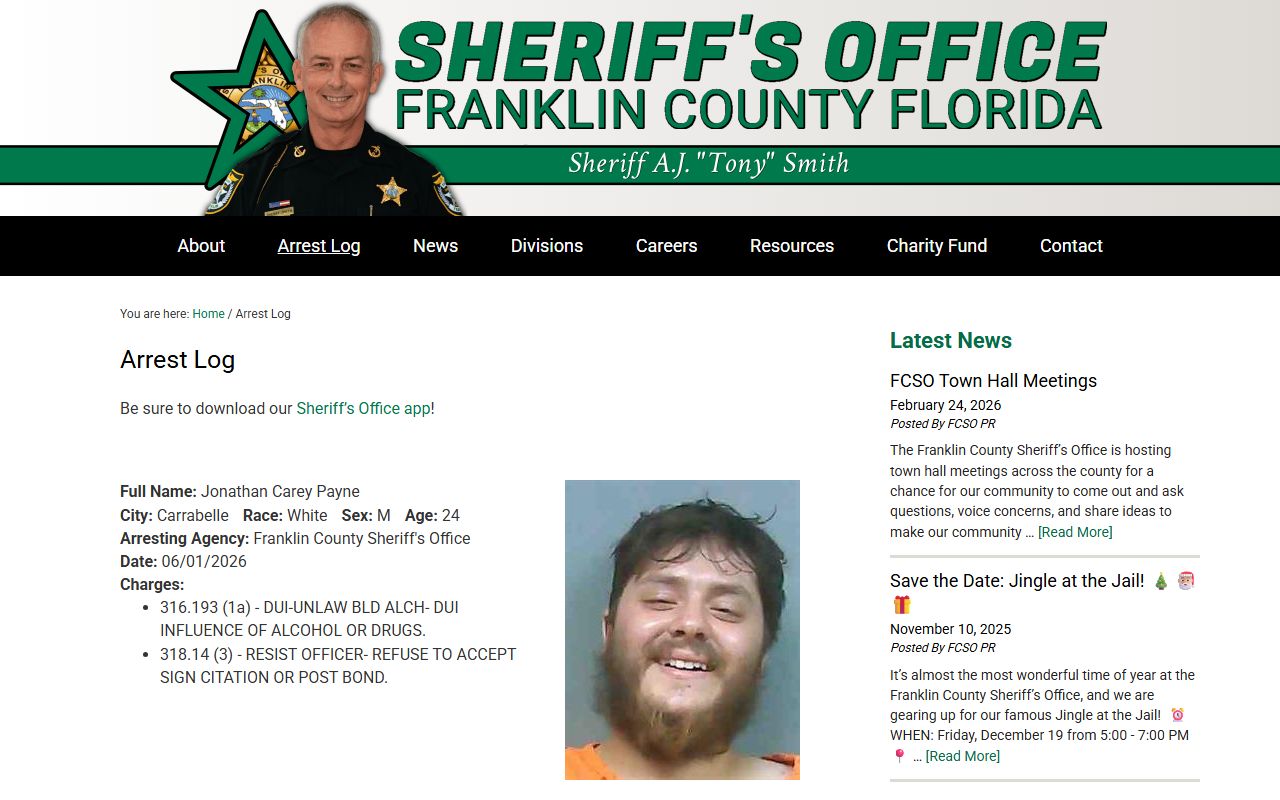
Each row pairs a photo with a name, city, race, sex, age, arresting agency, arrest date, and a charge list. That layout is what lets you confirm you have the right record, even without a search form to type a name into.
How to Find a Franklin County Booking Photo
Use these steps to locate a photo on the arrest log, then to request one if it is not posted.
- Open the official FCSO arrest log at the Sheriff's Office website.
- Review the newest entries on page one, then use pagination for older arrests.
- Match the record by full name, city, race, sex, age, arresting agency, date, and charges.
- If no photo is online, file a Chapter 119 public-records request with FCSO Public Records.
- Include the case number if known, or the incident location, date, and time to help identify the record.
Note: there is no log-specific search field, so a browser find command or a site-limited web search can speed up matching a name.
What a Franklin County Booking Photo Shows
The arrest log pairs the booking photo with a tight set of public fields. The inspected entry showed one photo, with no labels for angles or multiple views. Around it sit the demographic and arrest details. Some fields people expect, like bond, housing, and release status, were not in the inspected entry. The table sorts what is published from what is not.
| Field | Published? | What It Shows |
|---|---|---|
| Booking photo | Yes | One booking-photo-style image beside the entry; no angle labels. |
| Full name | Yes | Name of the arrested person. |
| City | Yes | City tied to the arrested person. |
| Race | Yes | Public demographic field. |
| Sex | Yes | Public demographic field. |
| Age | Yes | Age in years, not date of birth. |
| Arresting agency | Yes | FCSO or a city police agency may appear. |
| Arrest date | Yes | Shown in MM/DD/YYYY format. |
| Charges | Yes | Statute or citation plus a plain charge phrase. |
| Bond | No | Not shown in the inspected entry. |
| Housing | No | Not shown in the inspected entry. |
| Release status | No | Not shown in the inspected entry. |
One detail worth flagging is age versus date of birth. The log shows age in years, not a full birth date. That keeps a sensitive identifier off the public page while still helping you match a record. The charge line works the same way, pairing a statute or citation with a short phrase so a reader can see the alleged offense without legal jargon.
So the photo answers identity questions well. It does not answer custody questions. For housing, bond, or whether the person is still held, the Franklin County jail inmate records channel and the sheriff's office are the better route.
Are Franklin County Jail Mugshots Public Record?
In Florida, the answer leans yes. Arrest records are public under the state's broad records law, subject to exemptions. That is why booking photos can be posted online by the sheriff. Being public does not force every photo onto a website, though. The sheriff's local publication policy controls what shows on the arrest log, while the records law governs the access question and any copy request. Florida also has a specific statute aimed at sites that publish booking photos and charge to take them down.
Key Statutes:
Florida Statutes Chapter 119 - the public-records law that creates the general right to inspect and copy nonexempt records held by Florida agencies, including arrest records.
Florida Statutes § 119.07 - sets how agencies must allow inspection and copying within a reasonable time and what copy or service fees may apply.
Florida Statutes § 901.43 - regulates dissemination of arrest booking photographs, especially entities that publish them and then solicit or accept payment to remove them.
Section 901.43 matters most for anyone worried about a booking photo spreading to commercial sites. It targets the pay-to-remove model directly, which is why the records-clearing route below points to the law rather than to any removal vendor.
How Long a Mugshot Stays Online
This is the honest gap. The arrest log does not state how long photos remain online. Pagination reached page 234 in the inspected view, which suggests a deep historical archive. That depth hints at long retention. Still, the Sheriff's Office does not publish a written retention window, so any exact number would be a guess. The safe reading is that an entry can stay online well after release, and absence from page one does not prove an arrest never happened.
What is and isn't public: The arrest log publishes the booking photo plus full name, city, race, sex, age, arresting agency, arrest date, and charges. It does not publish bond, housing, or release status in the inspected entry. A booking photo also will not exist on the county log for someone held in federal custody, since the county jail does not book those cases.
Note: because the log can stay up after a case ends, the charge phrase shown there may differ from the final court charge filed by the prosecutor.
How to Request a Franklin County Booking Photo
When a booking photo is not posted online, the route is a Chapter 119 public-records request to the Sheriff's Office. The public-records contact is Dana Pavon, reachable at 850-670-4807 or PublicRecords@franklinsheriff.com. Requests can also go in person or by mail to 270 State Road 65, Eastpoint, FL 32328. The records counter runs Monday through Friday, 8:30 a.m. to 4:30 p.m., excluding holidays.
Include the case number if you have it. If not, give the incident location, the date and time, and the name of the person who contacted the sheriff to file the report. The office handles requests in the order received, and large or complex requests may carry duplication or special-service costs and take longer. Reports for open cases, or where a capias has been requested, may not be available to most requesters. A capias is a court order to arrest, often tied to a missed hearing, and it can hold a report back while the matter is still active.
Florida law lets a person request public records without giving a name, though the office still needs a way to deliver the response. Plan for some turnaround, especially during busy periods. A clear, specific request moves faster than a broad one, so naming the exact arrest, date, and person you want a photo for helps the records staff find it.
Mugshot Removal and Sealed Records
Removal depends on who is holding the photo. For an incorrect or outdated official FCSO record, the path is to contact the originating agency or the public-records office. The sheriff's inspected pages do not show a general mugshot removal form, so a direct request to that office is the practical move. This is a correction request, not an automatic takedown.
For commercial mugshot sites, Florida points to Florida Statutes § 901.43, which targets sites that publish booking photos and charge to remove them. Paying a removal service is not the advised step. If the underlying arrest qualifies, the lasting fix is a court process. Sealing or expunging an arrest runs through Florida Statutes § 943.0585 and related law, handled by the court and FDLE. That is a legal order, not a website edit, and the steps for it are covered with the court records after a jail arrest process.
Federal and State Booking Photos
County booking photos differ from state and federal records. A person sentenced to state prison moves into Florida Department of Corrections custody, and the FDC Offender Search may show a state inmate photo. That image is a state correctional record, not a county booking photo, and it follows a different system than the arrest log.
Federal custody works differently again. The Federal Bureau of Prisons does not publish federal mugshots the way county jails publish booking photos. You can confirm this by opening the federal BOP inmate locator below, which returns custody information rather than a booking-photo gallery.
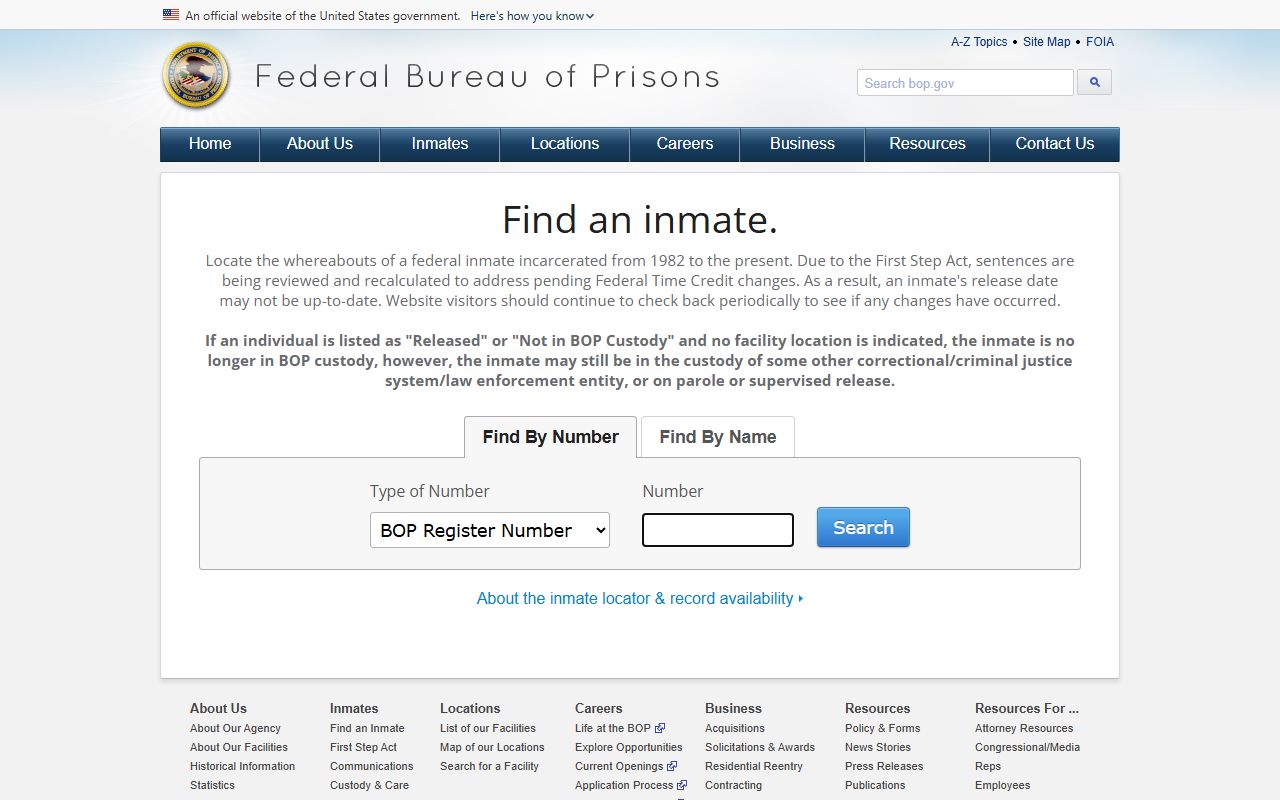
That contrast is the takeaway. For a federal case, search by BOP locator or the U.S. Marshals process instead of expecting a Franklin County mugshot. ICE Online Detainee Locator works the same way: it locates immigration detainees but does not run as a mugshot gallery.