
Franklin County Jail Records Overview
The Franklin County Sheriff's Office runs the local jail and publishes arrests online. Its public tool is the Arrest Log, and it lists people taken in by deputies, Apalachicola Police, and Carrabelle Police. The log shows a booking-style photo, name, city, and charges for each entry. It reads like a feed, not a database. There is no name box to type into and no live custody field. You scroll and page through entries instead, with the newest arrests at the top of page one.
One point matters most here. The arrest log is a publication, not a live roster. A person can show on the log yet already be released, bonded out, transferred, or sentenced. The page does not display housing, bond, or release status. So treat it as a record of an arrest, not proof of who sits in a cell today. When the real question is "is this person still in jail," the log alone cannot answer it. You will need the phone line or a records request, both covered below.
The log also stops at the county line. It does not track sentenced state prisoners, federal inmates, or people held on an immigration matter. Each has its own search tool. A felon shipped to state prison drops off the local view and shows up in the Florida Department of Corrections (FDC) system instead.
How to Use the Franklin County Arrest Log
The arrest log lives on the sheriff's website and opens to a list of recent bookings. You do not need an account, a login, or a case number to read it. What helps is a full name, an approximate arrest date, and the city the person is from. Those details let you match the right entry, since the log offers no search form of its own. Work through it in order.
- Open the official Franklin County Sheriff's Office Arrest Log. It loads as a paginated feed of arrest entries.
- Review the newest entries on page one. Each item is a record-style listing, not a profile you can search.
- Check the fields on each entry: photo, full name, city, race, sex, age, arresting agency, date, and the charge list.
- Use the page numbers and the Next link to reach older arrests. The archive runs deep, well past page 200.
- Confirm current custody by phone. The log does not publish housing, bond, or release, so call the sheriff's office when you need a live answer.
- File a Chapter 119 public-records request when the record is not online. Send it to the records contact with a case number, or with the incident date, time, and location.
Because there is no last-name field, a browser find (Control plus F) on a loaded page can speed up matching when you are close to the right date. The sheriff's mobile app also advertises an arrests feature, which gives a second way to reach the same kind of information from a phone.
Note: The arrest log can stay online after release, so finding a name there does not prove the person is in custody today.
Franklin County Arrest Log Search Fields
Most county jail pages give you a search form with a last-name box and a booking-number box. Franklin's inspected interface does not. The arrest log is a browsing feed with pagination, so the "fields" are the parts of each entry plus the controls that move you between pages. The table below lays out what the public interface offers, instead of a name-entry workflow that does not exist here.
| Field | Type | Required | Notes |
|---|---|---|---|
| Arrest log feed | Paginated list | N/A | No roster search form found; readers scroll and page through entries. |
| Page numbers | Pagination links | No | Page 1, 2, 3, ellipsis, page 234, and a Next link were observed. |
| Full name | Displayed field | N/A | Shown on each entry; there is no box to type a name into. |
| City | Displayed field | N/A | City tied to the arrested person, such as Apalachicola. |
| Date | Displayed field | N/A | Arrest date in MM/DD/YYYY format. |
| Charges | Displayed list | N/A | Statute citation plus a plain-language charge phrase. |
Detail from the sheriff's detention division shows how jail operations sit behind the public log. The FCSO Detention division page describes the staff who run intake and housing.
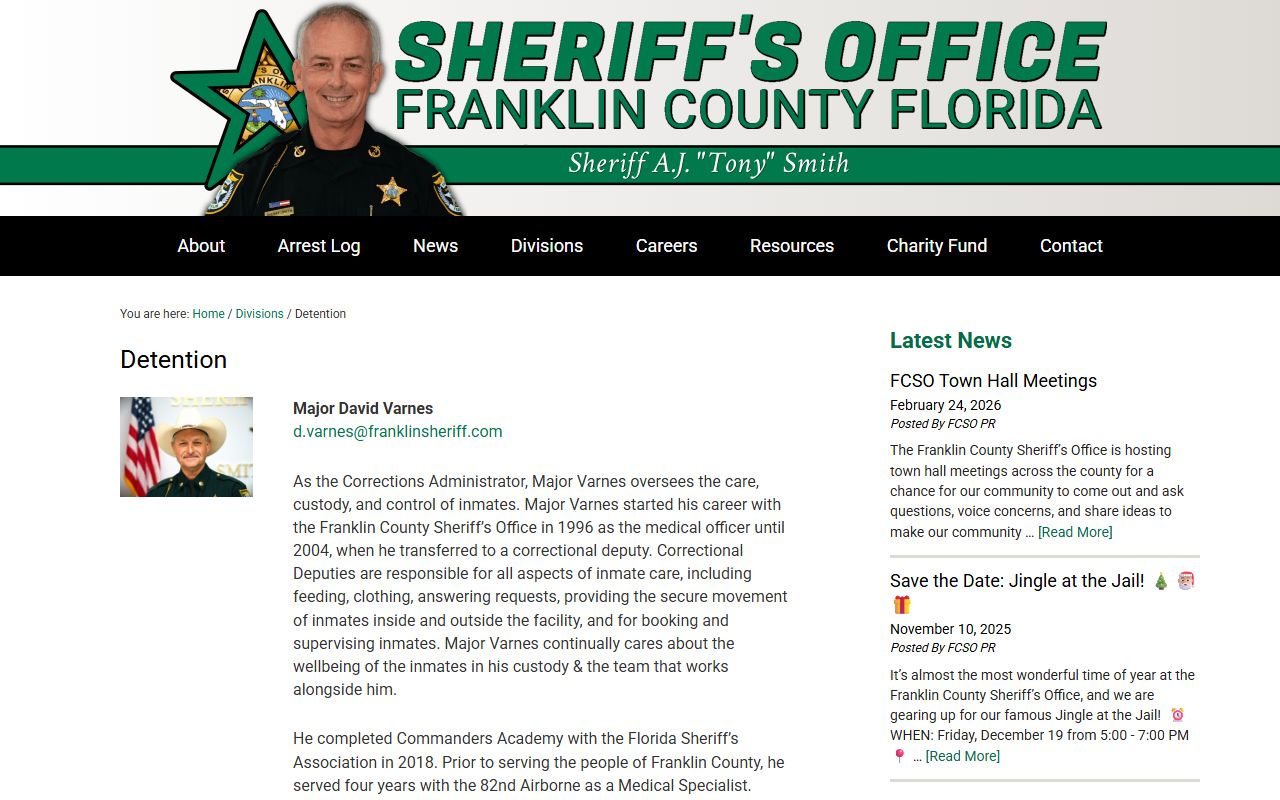
That division handles the booking and custody work that the arrest log only partly reflects, which is why housing and release status stay off the public feed.
What a Franklin County Arrest Record Shows
Each arrest-log entry is a snapshot of one booking, not a full case file. It tells you who was arrested, by which agency, and on what charges, with a photo for matching. It does not tell you whether the person made bond, where they are housed, or when they go to court. The split between what is shown and what is hidden is the most useful thing to learn first, so the table sorts every field that way.
| Field | What It Shows |
|---|---|
| Booking photo | Shown. A booking-style image sits beside each arrest entry. |
| Full name | Shown. The name of the arrested person. |
| City | Shown. The city tied to the arrested person. |
| Race | Shown. A demographic field in the public entry. |
| Sex | Shown. Listed as a single-letter value, such as M. |
| Age | Shown. Age in years, not a birth date. |
| Arresting agency | Shown. FCSO, Apalachicola PD, or Carrabelle PD may appear. |
| Date | Shown. Arrest date in MM/DD/YYYY format. |
| Charges | Shown. A list pairing a statute citation with a charge phrase. |
| Booking number | Not shown in the inspected entry. |
| Bond amount | Not shown in the inspected entry. |
| Housing unit | Not shown in the inspected entry. |
| Court date | Not shown in the inspected entry. |
| Release status | Not shown in the inspected entry. |
The charge phrase on the log is an arrest-side charge. It can differ from the formal charge a prosecutor later files, which is why the court record matters once a case opens. For booking photos specifically, the same log is the first stop, and the jail roster mugshots page covers how those images are governed and matched. For the formal charges that follow an arrest, see the guide on court records after a jail arrest.
Common Franklin County Jail Terms
Jail records use a handful of words that carry weight. A bond figure, a hold, or a status word can decide whether a person walks out or stays. The short list below defines the terms most likely to come up while you read an arrest log or call the jail.
- Booking
- The intake process that records an arrest, identity, charges, fingerprints, photo, and custody status.
- Intake
- The first jail step, where a new arrestee is searched, screened, photographed, and entered into jail records.
- Classification
- The process that decides an inmate's housing and supervision level. It is not shown on the public log.
- Detainer
- A hold or notice from another agency that can block release even after local bond is posted.
- Capias
- A court order to arrest, often issued after a missed court date or an unresolved case event.
- No-bond hold
- A custody status where release by bond is not allowed at that time.
- Time served
- A disposition where jail time already spent counts toward, or satisfies, the sentence.
Franklin County, State, and Federal Inmate Lookups
The biggest mistake people make is searching the wrong system. The county arrest log covers local arrests and pretrial holds. Once a person is sentenced to state prison, the record moves to the Florida Department of Corrections. Federal and immigration custody are separate again. The table sorts the custody type to the tool that holds the record.
| Custody type | Where to look |
|---|---|
| Local arrest or pretrial hold | FCSO Arrest Log, plus the jail phone line for live status |
| Sentenced state prisoner | Florida Department of Corrections (FDC) Offender Search |
| Federal inmate | Federal Bureau of Prisons inmate locator |
| Immigration detainee | ICE online detainee locator |
| Custody-status notification | VINELink Florida alerts |
For sentenced state prisoners, use the FDC Offender Search, which lists a DC number, facility, and sentence data. Federal inmates appear in the BOP inmate locator, and immigration detainees in the ICE detainee locator. Franklin County's own state prisons, Franklin Correctional Institution and Franklin Work Camp, both hold sentenced inmates found through FDC, not through the county log.
Franklin County Public-Records Requests
When a record is not online, Florida's public-records law gives you a path to ask for it. The sheriff's office processes requests under Chapter 119 and assigns a records officer to handle them. A clear request moves faster, so include a case number when you have one. If you do not, give the incident date, time, and location. Open cases, or cases where a capias has been requested, may be withheld from most requesters.
The sheriff's public-records page explains the process and what the office can release. The FCSO public-records division page sets out how to submit a Chapter 119 request.
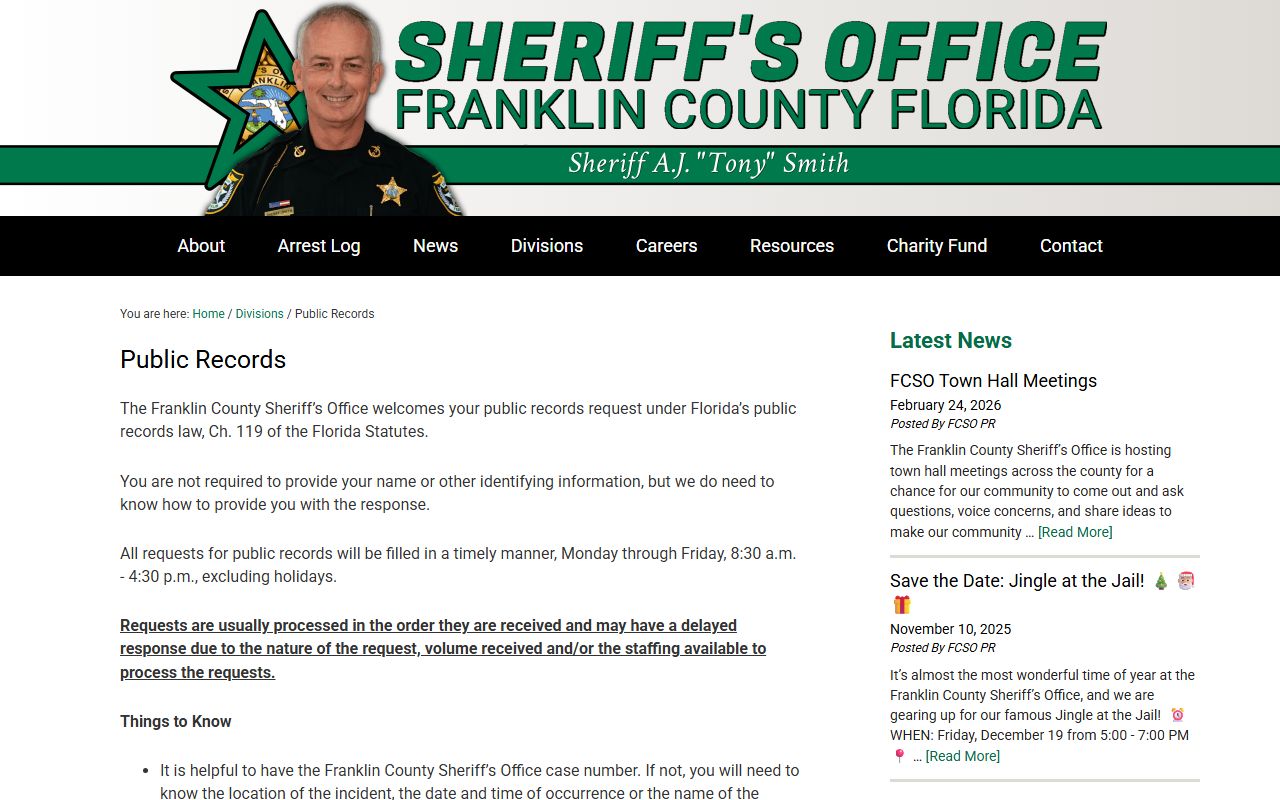
Use that channel for booking records, arrest reports, or photos that do not appear on the public log, and send your request to the records contact listed below.
Franklin County Sheriff's Office / Jail
270 State Road 65
Eastpoint, FL 32328
850-670-8500
Main jail and sheriff contact
Public Records Contact
Dana Pavon, Records
PublicRecords@franklinsheriff.com
850-670-4807
Mon to Fri, 8:30 a.m. to 4:30 p.m.
Note: Records counter hours are not visitation hours, and the office processes requests in the order received, so allow time for volume and staffing delays.
Booking and Intake in Franklin County
An arrest starts the chain that ends with a log entry. A deputy or city officer makes the arrest, then brings the person to the sheriff's jail complex for local booking. Intake collects identity details: name, age, race, sex, and fingerprints. Staff take a booking photo, which may later appear on the public log. Booking charges go in next, written as a statute citation paired with a plain charge phrase.
From there the path can split. The jail screens new arrivals for medical and mental-health needs, then classification decides housing, though housing never shows on the public feed. A held person is escorted to court, where a judge reviews probable cause, counsel, and release conditions at first appearance. After court, the person may be released, kept in custody, or transported to state prison once sentenced. The 2024 annual report counted 671 bookings, 153 court escorts, and 32 transfers to the Department of Corrections, which traces that arrest-to-court-to-prison route (Franklin County Sheriff's Office 2024 Annual Report).
Visitation and Inmate Communication
This is where honesty matters. Research did not locate a published Franklin County Jail visitation schedule, dress code, visitor-ID rule, mail format, or deposit fee list on the inspected sheriff pages. So none are invented here. What the sheriff does publish are vendor links from its Resources menu for video visits and inmate accounts. Confirm availability, times, and fees with the jail or the vendor before you plan anything.
The sheriff's Resources menu links HomeWAV for video visitation and CommissaryDeposit for inmate funds. Treat these as the official-menu vendors, then verify the specifics directly. The optional table below shows the local details that were not published, so you know exactly what to ask about rather than assume.
| Item | Status | What to do |
|---|---|---|
| In-person visit schedule | Not published | Confirm days and times with the jail. |
| Video visitation | HomeWAV vendor linked | Confirm availability and fees with the vendor. |
| Visitor ID and dress code | Not published | Confirm rules with the jail before visiting. |
| Mail format | Not published | Confirm the address format with the jail. |
| Commissary deposits | CommissaryDeposit vendor linked | Confirm methods and fees with the vendor. |
For a sentenced person at Franklin Correctional Institution or Franklin Work Camp, the jail's vendors do not apply. State-prison visits, mail, phone, and funds follow FDC statewide rules instead, so use the Department of Corrections channels for anyone already in state custody.
Franklin County Sheriff App and Alerts
Beyond the website, the sheriff offers a mobile app that advertises an arrests feature. It supplements the arrest log rather than replacing it, and it does not confirm live custody. The app page lists access to arrests, sex offenders, Amber alerts, news and events, social links, a narcotics hotline, a location tool, crime-tip submission, deputy commendations, and general comments. The same page warns that the app is not monitored 24/7 and that emergencies should go to 911.
You can reach the install instructions through the sheriff's site. The FCSO app download page directs users to search their app store for the official Franklin County Sheriff's Office app.
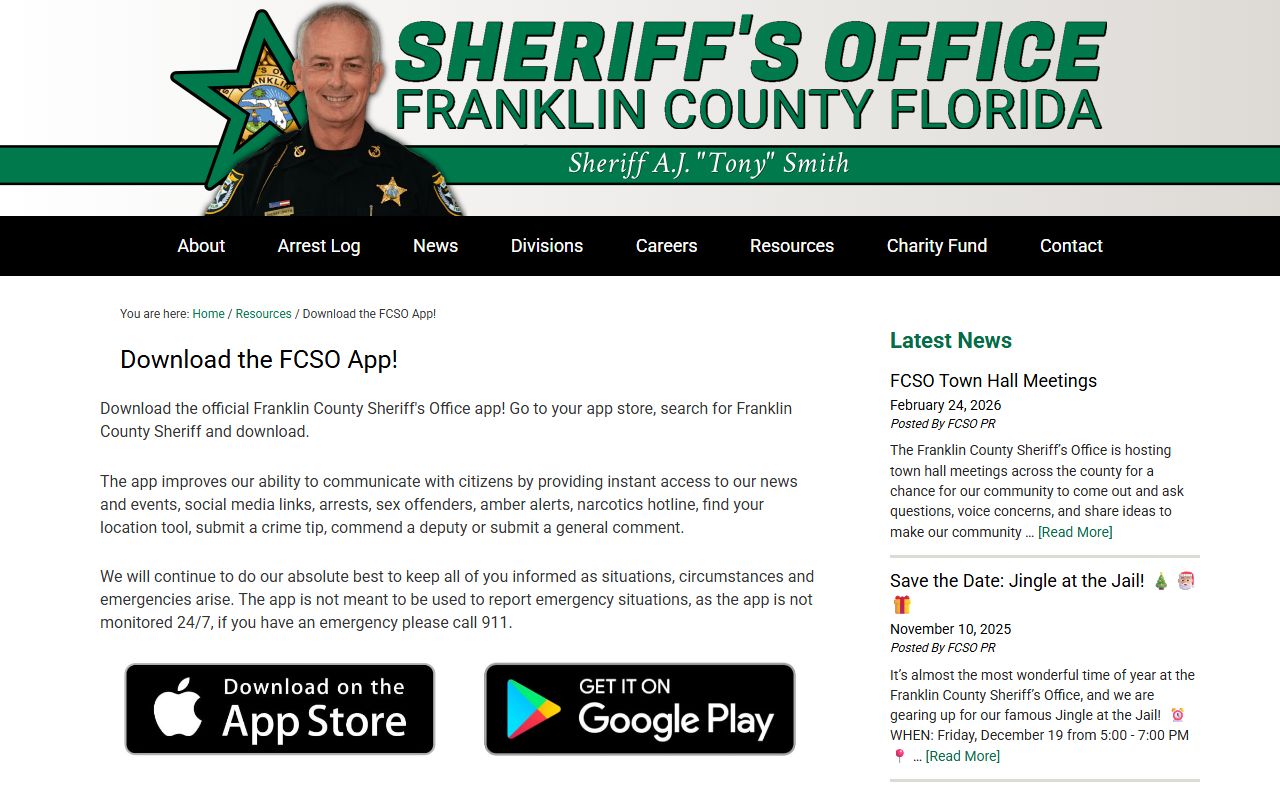
Because the app is not a confirmed live roster, use it as one more arrest-access channel, then fall back to the phone line and public-records process for any current custody question.
Release Alerts and Other Channels
Sometimes you do not need a record copy. You need to know the moment custody status changes. Florida offers a notification service for that, built for victims and family who want alerts about a move or release. It is a status service, not the originating jail record, so pair it with the log or the jail line for the underlying detail.
Sign up through VINELink Florida to register for custody-status notifications. The service tracks status changes across participating Florida facilities.
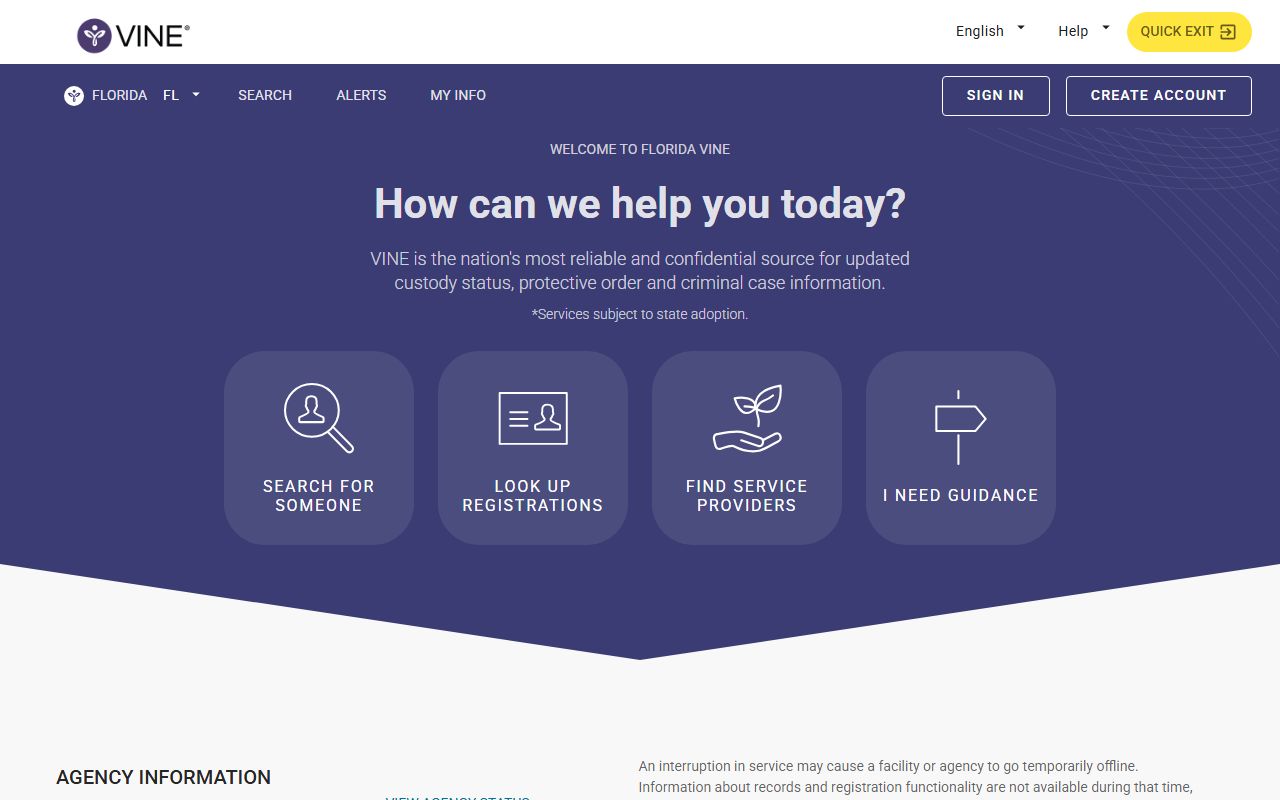
Putting it together, the full access chain runs from the arrest log, to the jail and sheriff phone line, to in-person contact, to a Chapter 119 records request, then out to the FDC, BOP, and ICE locators and VINELink for anyone outside county custody. The sheriff app adds one more arrest-access channel.
Note: Confirm a person's current custody with the jail before you send money or schedule a visit, since the public log can lag behind a release, transfer, or sentencing.